
By Tetiana Pochetova – Journalist
By redefining space as an industrial ecosystem rather than a series of heroic missions, Jeff Bezos presented a vision in Paris that connected artificial intelligence, advanced manufacturing, reusable rockets, and the future of civilization.
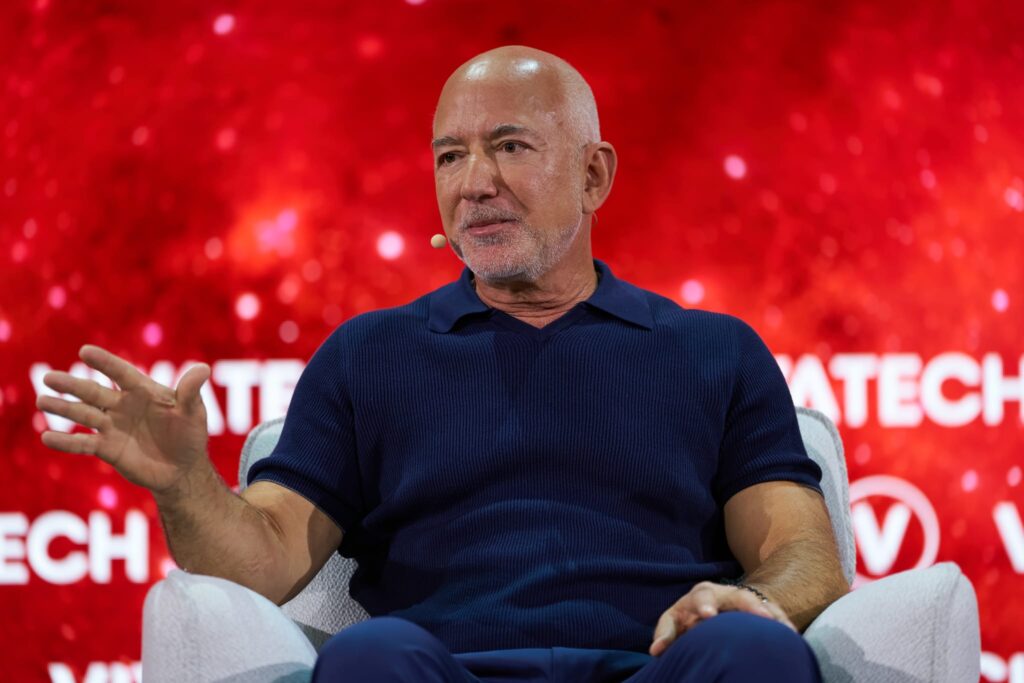
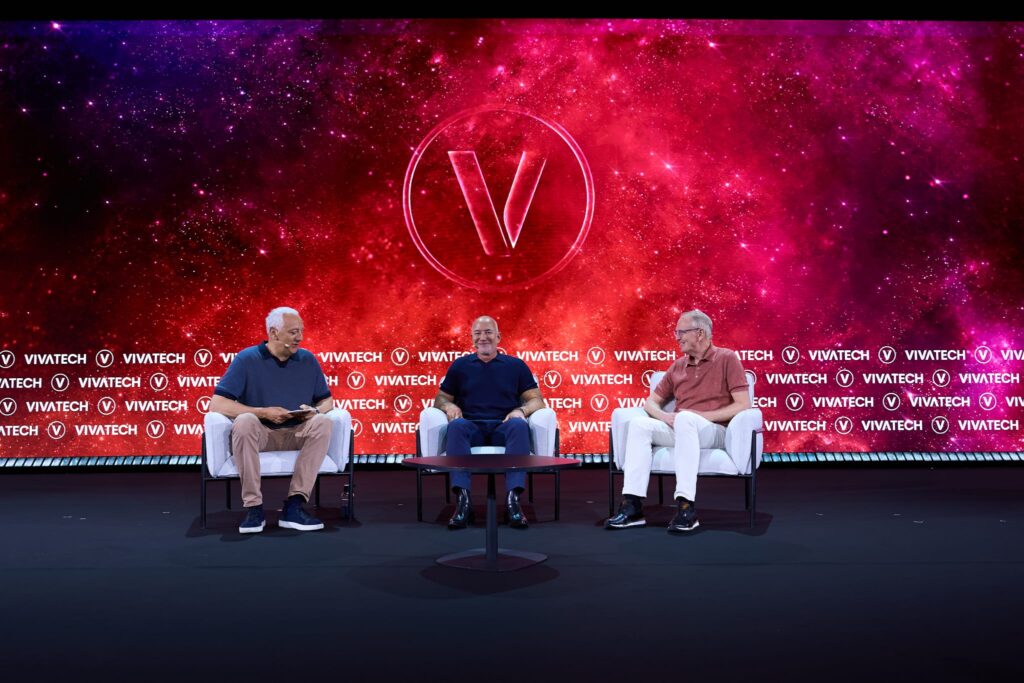
The conversation surrounding artificial intelligence often revolves around automation, productivity, and fears of job displacement. Discussions about space exploration, meanwhile, typically focus on ambitious missions to the Moon or Mars. At VivaTech 2026 in Paris, Jeff Bezos connected these seemingly separate narratives into a single long-term vision: humanity’s future depends on building the industrial infrastructure that allows both AI and space exploration to flourish together.
Speaking alongside Blue Origin CEO Dave Limp, Bezos outlined a strategy extending far beyond rocket launches. His central argument was that space is not simply another destination to explore—it is the next industrial frontier. Reaching that frontier, however, requires solving fundamental engineering, manufacturing, and economic challenges before humanity can truly become a spacefaring civilization
Every ambitious engineering program encounters setbacks. Rather than avoiding this reality, Bezos emphasized that failures and unexpected events are inseparable from technological progress.
Following a recent launchpad anomaly, Blue Origin accelerated recovery efforts by utilizing existing infrastructure while construction teams worked continuously to restore operations. More important than the technical recovery, however, was what the company’s response revealed about its organizational culture.
The message was straightforward: resilience matters more than perfection. Successful engineering organizations learn rapidly, adapt decisively, and maintain momentum despite temporary failures. In industries where development cycles span years and investments reach billions of dollars, this mindset becomes a strategic advantage rather than merely an inspirational slogan.
The willingness to continue despite adversity reflects an understanding that difficult goals demand extraordinary persistence.
Popular culture often portrays space exploration through dramatic launches and visions of permanent settlements on distant planets. Bezos presented a more practical sequence of priorities.
Before humanity can establish thriving communities beyond Earth, it must first construct the equivalent of highways, ports, railroads, and logistics networks in space. Reusable launch systems, high-frequency manufacturing, orbital transportation, and reliable access to orbit form the essential infrastructure upon which every future enterprise will depend.
He compared today’s launch industry to the early days of the internet. Just as internet infrastructure enabled countless entrepreneurs to build businesses that could not previously exist, inexpensive and reliable access to space could unlock industries that remain unimaginable today.
This perspective reframes rockets not as the ultimate achievement but as enabling technology.
Their true value lies in dramatically reducing the cost of reaching orbit.
One of the strongest themes emerging from the discussion was the economic importance of reusable launch vehicles.
Every successful landing of a booster represents more than a technical milestone. It transforms the economics of spaceflight.
As launch costs decrease, satellites become cheaper to deploy. Lower satellite costs stimulate demand for communications, Earth observation, national security capabilities, scientific research, and commercial services. Growing demand justifies additional investment in launch infrastructure, creating a reinforcing cycle of innovation and economic expansion.
Blue Origin’s recent missions demonstrate that reusable systems are gradually transforming this vision into operational reality.
Rather than celebrating isolated achievements, Bezos focused on creating systems capable of operating repeatedly, reliably, and economically.
Building one exceptional rocket differs fundamentally from building thousands.
Bezos argued that long-term success depends less on designing extraordinary vehicles than on designing extraordinary manufacturing systems.
Echoing a philosophy often associated with modern industrial production, he highlighted the importance of “building the machine that builds the machines.”
This requires extensive vertical integration.
Blue Origin develops its own engines, manufactures critical components internally, and invests heavily in specialized production facilities. Such integration provides greater control over quality, innovation, production speed, and long-term costs.
Rocket engines represent perhaps the most demanding engineering systems humanity has ever created. Operating under extreme temperatures and pressures requires advanced metallurgy, new alloys, and continuous improvements in manufacturing precision.
The discussion of engines such as the BE-4 and BE-7 illustrated that breakthroughs often arise not from singular inventions but from sustained refinement over many years.
Public imagination frequently places Mars at the center of humanity’s future in space.
Bezos offered a different strategic roadmap.
The Moon, he argued, should become humanity’s first permanent foothold beyond Earth.
Its relative proximity dramatically simplifies transportation, communication, emergency response, and logistics compared with Mars. Even more significant is the presence of water ice, which can potentially be converted into oxygen and hydrogen—critical resources for life support and rocket fuel.
Developing sustainable lunar infrastructure therefore represents not merely scientific exploration but practical economic development.
A permanent lunar presence could eventually support missions deeper into the Solar System while simultaneously enabling industries that are impossible to establish solely from Earth.
Perhaps the most provocative idea presented during the session concerned Earth’s environmental future.
Bezos envisioned a civilization in which energy-intensive and polluting industries gradually migrate into space, allowing Earth itself to become primarily a residential and ecological planet.
Rather than viewing environmental protection and industrial growth as opposing goals, he suggested they could ultimately become complementary.
Manufacturing, large-scale energy generation, and other resource-intensive activities could eventually operate beyond Earth’s atmosphere, reducing environmental pressures while expanding humanity’s productive capacity.
Whether this vision unfolds over decades or centuries remains uncertain. Nevertheless, it reflects a distinctly long-term perspective on sustainability—one that seeks solutions through technological expansion rather than resource limitation alone.
Launch vehicles represent only one layer of a much larger ecosystem.
The discussion expanded to satellite constellations providing high-bandwidth communications, future orbital computing platforms, and the possibility of space-based data centers powered continuously by solar energy.
Unlike terrestrial facilities constrained by weather and nighttime cycles, orbital infrastructure could potentially access uninterrupted solar power.
As artificial intelligence increases global demand for computing resources, such concepts may eventually become economically attractive.
Although still exploratory, these ideas illustrate how the space economy increasingly intersects with digital infrastructure.
Space is evolving from a destination into a platform for computation, communication, manufacturing, and commerce.
Perhaps the most immediate technological application discussed involved artificial intelligence itself.
Blue Origin’s internal initiative, Prometheus, aims to accelerate engineering rather than replace engineers.
Instead of functioning as a general-purpose conversational system, the platform is designed around highly specialized engineering knowledge. Its objective is to shorten the journey from concept to physical product—the “dream-build cycle.”
If engineering timelines can shrink from ten years to only a few, innovation could accelerate dramatically.
Rather than eliminating human creativity, AI becomes an amplifier of it.
Bezos suggested that the greatest constraint on innovation may no longer be technical capability but the speed with which ideas can become reality.
One of the more unexpected observations concerned the future of employment.
Contrary to widespread concerns that AI will eliminate jobs, Bezos argued that sufficiently powerful AI could produce the opposite outcome.
As technology enables entrepreneurs, scientists, and engineers to pursue vastly more projects than before, demand for skilled people may increase faster than supply.
The limiting factor becomes human imagination and execution rather than computational capability.
This perspective reframes AI as an engine of economic expansion instead of simple automation.
History offers numerous examples in which transformative technologies created entirely new industries that ultimately employed more people than they displaced.
Whether AI follows the same trajectory remains uncertain, but Bezos encouraged audiences to consider this more optimistic possibility.
Underlying every topic—from reusable rockets to lunar industry and AI engineering—was a consistent philosophy of leadership.
Meaningful innovation requires patience.
Organizations pursuing transformational goals must be willing to invest across decades, accept temporary failures, and make decisions that may not generate immediate returns.
This long-term orientation distinguishes infrastructure builders from product developers.
Products solve today’s problems.
Infrastructure enables tomorrow’s opportunities.
Throughout the discussion, Bezos repeatedly returned to this distinction.
Building civilization’s next chapter depends less on spectacular moments than on disciplined execution, industrial capability, and persistent engineering excellence.
The ideas presented at VivaTech 2026 extend well beyond Blue Origin.
They describe a future in which artificial intelligence accelerates engineering, reusable rockets dramatically reduce transportation costs, manufacturing expands beyond Earth, and the Moon evolves into humanity’s first permanent industrial outpost.
Whether every prediction materializes exactly as envisioned remains an open question.
Yet the broader message resonates regardless of specific timelines: civilization advances when it invests in foundational infrastructure.
Just as railroads transformed continents and the internet reshaped the global economy, the infrastructure now being built for space may define the next century of technological progress.
The conversation in Paris was therefore not simply about rockets or AI.
It was about creating the systems that make entirely new industries—and perhaps entirely new civilizations—possible.








Copyright © 2026 VANITY VIP Magazine. All rights reserved
We use cookies to improve your experience on our site. By using our site, you consent to cookies.
Manage your cookie preferences below:
Essential cookies enable basic functions and are necessary for the proper function of the website.
These cookies are needed for adding comments on this website.