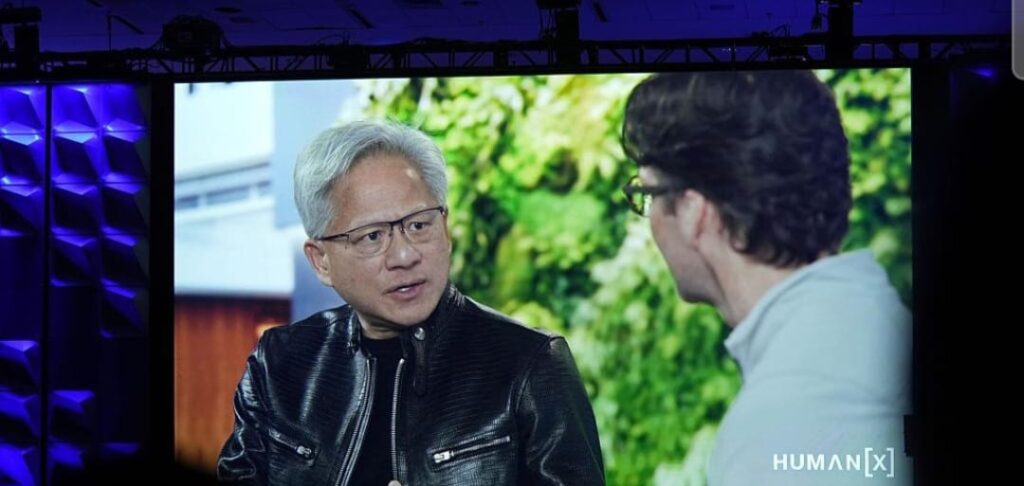
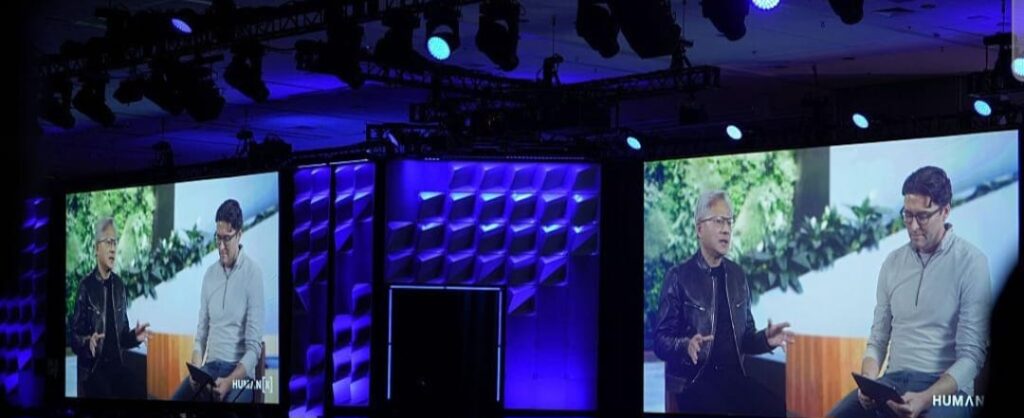
At HumanX 2026 in San Francisco, NVIDIA founder and CEO Jensen Huang joined HumanX CEO Stefan Weitz for a wide-ranging conversation about the future of artificial intelligence, enterprise adoption, and the opportunities emerging from the next phase of computing. The discussion focused on how leaders can use AI to create business value, how organizations should adapt their teams, and how NVIDIA itself approaches AI adoption.
Huang argued that the AI revolution is much broader than the current focus on large language models and chatbots. While language-based systems are an important part of the technology landscape, he emphasized that AI includes many different types of models designed to understand and represent information across fields such as biology, physics, chemistry, and other domains. In his view, AI represents a much larger industrial transformation with applications extending far beyond conversational systems.
One of Huang’s central messages was that organizations cannot rely only on analysis and certainty when pursuing breakthrough opportunities. He noted that innovation requires experimentation and learning from failure, describing failure as another form of experience and another data point. His message to business leaders was that transformative opportunities often require action before every outcome can be predicted.
For enterprises, this means moving beyond small-scale trials and considering how AI can reshape operations, products, and decision-making. Huang suggested that companies have an opportunity for significant improvement if they are willing to engage seriously with the technology rather than waiting for complete clarity.
The conversation highlighted a shift in how businesses should think about artificial intelligence. Instead of viewing AI as a single technology, Huang described it as a broad ecosystem of models, infrastructure, and applications. The next generation of AI adoption will depend on organizations identifying where intelligent systems can deliver practical value.
This perspective reflects NVIDIA’s broader view that AI development is supported by multiple layers, including computing infrastructure, models, and applications. HumanX discussions around the AI ecosystem also emphasized that progress depends on the interaction between these different layers rather than on models alone.
Huang’s message to executives was not simply about adopting new tools; it was about adapting organizations to a period of rapid technological change. The leaders who succeed, he suggested, will be those who understand how to integrate AI into their businesses and encourage a culture of experimentation.
As AI moves from a research breakthrough toward widespread enterprise use, Huang’s HumanX appearance reinforced a broader message: the companies that learn, adapt, and build with AI will have a stronger position in the years ahead.
Jensen Huang’s message at HumanX 2026 was clear: AI is not a future possibility waiting to arrive — it is a transformation already underway, and organizations must decide how actively they will participate.


Copyright © 2026 VANITY VIP Magazine. All rights reserved
We use cookies to improve your experience on our site. By using our site, you consent to cookies.
Manage your cookie preferences below:
Essential cookies enable basic functions and are necessary for the proper function of the website.
These cookies are needed for adding comments on this website.